
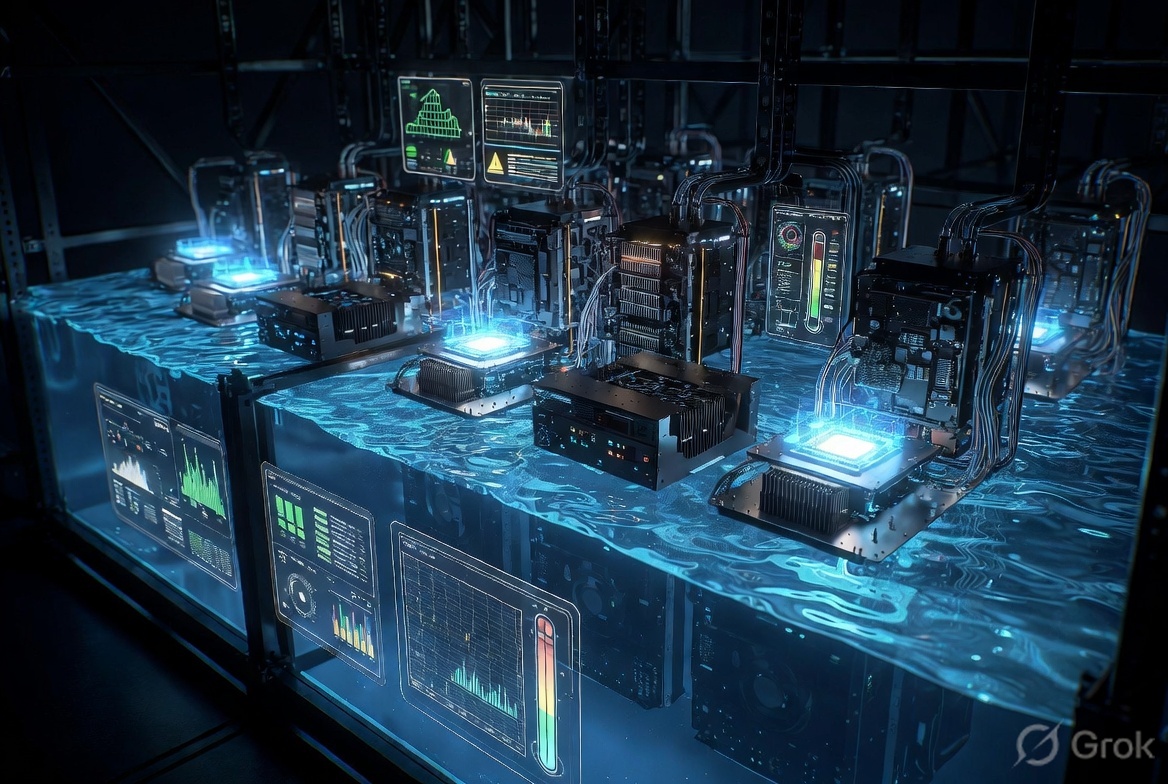
Liquid Immersion Cooling | Data Center Cooling | Two-Phase Cooling | Regional Breakdown | April 2026 | Source: WGR
Data Center Liquid Immersion Cooling Market
Key Takeaways
-
Data Center Liquid Immersion Cooling Market is projected to reach USD 8.6 billion by 2035 at a 32.4% CAGR.
-
Single-phase and two-phase immersion cooling for AI/HPC clusters are the dominant structural growth drivers.
-
Direct-to-chip liquid cooling is gaining traction among hyperscale operators demanding higher rack densities.
-
LiquidStack, Submer, GRC (Green Revolution Cooling), Midas, and Vertiv lead competitive supply.
-
North America leads adoption; Asia-Pacific accelerates through AI infrastructure investment.
The Data Center Liquid Immersion Cooling Market is projected to grow from USD 0.68 billion in 2024 to USD 8.6 billion by 2035 at a 32.4% CAGR, driven by the mass-market adoption of immersion cooling across AI/ML and HPC data centers, the expansion of rack densities beyond air-cooling limits (50-100kW+ per rack), and the proliferation of two-phase immersion cooling that directly reduces PUE to 1.02 and eliminates water usage.
Market Size and Forecast (2024-2035)
Segment & Technology Breakdown
What Is Driving the Data Center Liquid Immersion Cooling Market Demand?
-
AI/ML Power Density: GPU clusters for AI training require 3-5x higher cooling capacity than CPU racks, with immersion cooling supporting 100-200kW per rack vs. 10-20kW for air cooling, enabling dense AI infrastructure.
-
PUE Regulations: ASHRAE and EU energy efficiency mandates are driving adoption, with immersion cooling achieving PUE below 1.05 (vs. 1.3-1.5 for air cooling), reducing energy costs by 30-50%.
-
Water Conservation: Data center water usage is under regulatory scrutiny, with immersion cooling using zero water for cooling (vs. 1-2M gallons/day for evaporative cooling), appealing to water-stressed regions.
-
Server Reliability: Immersion cooling eliminates fans, reducing vibration and component failure, with immersion-cooled servers reporting 2-3x longer component life and lower failure rates.
KEY INSIGHT
Hyperscale operators deploying two-phase immersion cooling for AI clusters report PUE reduction from 1.35 to 1.02, 50% lower cooling energy costs, and elimination of water usage, with 10-20% higher server density per square foot.
Get the full data — free sample available:
→ Download Free Sample PDF: Liquid Immersion Cooling Market
Includes market sizing, segmentation methodology, and regional forecast tables.
Regional Market Breakdown
Competitive Landscape
Outlook Through 2035
Immersion cooling standardization for AI clusters, direct-to-chip adoption for mainstream servers, and waterless cooling mandates will define the data center liquid immersion cooling market through 2035. Vendors investing in dielectric fluid innovation, modular immersion tanks, and retrofit solutions will capture the highest-margin hyperscale and colocation contracts as liquid cooling transitions from niche HPC solution to standard data center infrastructure.
Access complete forecasts, segment analysis & competitive intelligence:
→ Purchase the Full Data Center Liquid Immersion Cooling Market Report (2025-2035)
*10-year forecasts | Segment & application analysis | Regional data | Competitive landscape | 350+ pages*
Keywords: Liquid Immersion Cooling | Data Center Cooling | Two-Phase Cooling | Single-Phase Cooling | Direct-to-Chip Cooling | AI Cooling | PUE Reduction | Immersion Fluid
© 2025 WiseGuy Reports (WGR) · All Rights Reserved · wiseguyreports.com
All market projections are forward-looking estimates sourced from WGR’s proprietary research reports and subject to revision.